DALLIN C. WILKS PHOTO
  • HOME
  • UTAH JAZZ
  • UTAH HOCKEY CLUB/MAMMOTH
  • SLC STARS
  • BYU SPORTS
  • WEDDINGS
  • MISC. WORK
    • ALL STAR CAMPAIGN
    • ALONE ON THE ROAD
    • AN AUTOPSY OF FAITH
    • BYUTV SPORTS HOSTS
    • HORROR MOVIE POSTERS
    • JAZZ CONTENT DAY 2022
    • JAZZ CONTENT DAY 2023
    • JAZZ CONTENT DAY 2024
    • JAZZ TEAM STORE
    • MAMIYA SPEC AD
    • PHOTO STUDENTS
    • TINTYPE TRIPTYCHS
  • BLOG
  • ABOUT
WITHIN AND BEHIND THE LENS
​
with Dallin C. Wilks

archives:

December 2025
September 2025
August 2023
May 2023
October 2022
September 2022
June 2022
April 2022
January 2022
December 2021
November 2021
October 2021
September 2021
August 2021
May 2021
December 2020
November 2020
September 2020
January 2020
December 2019
September 2019
April 2019
March 2019
January 2019
October 2018
August 2018
April 2018
February 2018
December 2017
November 2017

A New (Old) Camera for 2019

3/5/2019

 
To start off the new year, I purchased in Salt Lake City an excellently preserved Mamiya C3 TLR 120mm film camera. I felt it was time to take another leap of faith in my photography progression, so consequently, I invested in this beautiful camera. For the past 2 months, photographing with this Mamiya has been a delightful challenge.

The Mamiya C3 was released in the early 1960's as a part of Mamiya's "C-Series" TLR medium format interchangeable-lens cameras (see Wikipedia). TLR cameras function much differently than the popular SLR (and DSLR) cameras, because it works with two lenses (hence, TLR means "twin lens reflex") - the top lens is essentially the viewfinder, and the bottom lens is where the photograph is taken. The top half of the camera body solely functions as the viewfinder, with the focusing screen reflecting directly what the top lens sees, and the bottom half of the camera body solely functions as the photographing chamber, where the image seen through the bottom lens is projected onto the 120mm-format film.

​In an SLR, when releasing the shutter, the internal mirror reflecting the image through the viewfinder will flip to expose the image onto the film behind the mirror, so the photograph being taken is exactly as the viewer sees it. But in this Mamiya C3, the mirror inside does not flip at all - the shutter release is actually built into the bottom lens of the TLR dual lens! It's phenomenal workmanship that honestly I cannot explain effectively, but to put it simply, the lens itself opens and shuts like a shutter curtain, while also snapping the aperture leaves into the desired aperture size.

The diagrams below should help in understanding the differences between an SLR and a TLR:
Clearly, there are some pretty significant differences here. I would like to list the most significant differences in my experience from working with an SLR to this Mamiya TLR:

​1. the film negatives are much larger (went from 35mm in my SLR to 120mm), which leaves less room for frames (less shots per film roll).

2. I have no built-in light meter, so I do lots of guess work based on the "Sunny 16" photography rule (see Wikipedia).

3. since what I am seeing through the viewfinder is not exactly the image being captured (since the viewfinder sees through a different lens) I have to compensate for parallax effects, especially with close up shots [side note: "parallax" is basically like looking at something really close with both of your eyes, then closing one and seeing the object move because of the space between your eyes - that is what a TLR camera is like because of its dual lens].

4. everything I see in the viewfinder is flipped, so when I move to the right, it appears through the viewfinder that I am moving left, and vice versa and so forth.
​
5. loading film is pretty challenging, I actually once wasted a roll of film just because I entirely messed up the loading process.

6. the viewfinder usually functions as a waist-level viewfinder (meaning I hold the camera in front of me near my stomach and look down into the viewfinder).

7. because of points 1-6, it takes me much longer to photograph.

8. also, the crop of every photograph shot on the Mamiya is square-oriented (6x6).

So naturally, one would ask, why work with a camera such as the Mamiya C3?

Firstly, overall, I really enjoy the activity of "slowing down" with photography, and my Mamiya C3 forces me to do exactly that. Photographing on a digital camera doesn't quite recreate as effectively as does shooting on film, because with film photography, every image counts, and therefore, I am forced to slow down, inhale everything around me, evaluate exactly what sights resonate with me, and then attempt to express those resonated emotions through a photograph. For me, digital photography over time became too quick and too convenient, which is why I decided nearly 4 years ago to try shooting film. I personally think something essential is lost on the art of photography when the photographer doesn't slow down enough to recreate and discover through his or her surroundings. Thus, photographing for the past 2 months with the Mamiya C3 has strongly reinforced that very concept for me, and has reinvigorated within me a newfound love for photography.

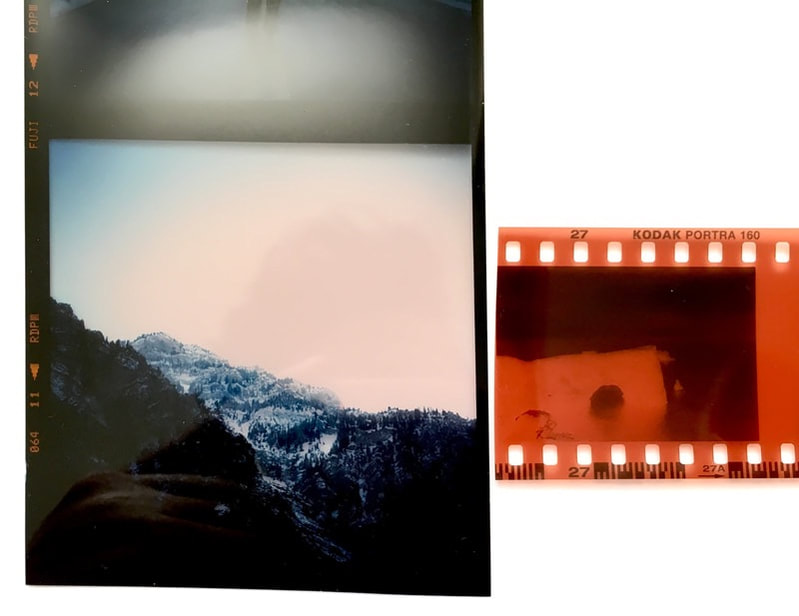
Secondly, I think the film negatives shot on 120mm are absolutely stunning, and the Mamiya C3 performs splendidly. The quality of 120mm film is what initially attracted me to purchasing a new film camera. I still wanted to shoot film, but I wanted to work with a higher quality film than 35mm. I recognized that the next size up from 35mm was 120mm (coined the "medium-format" size in film photography), which more than doubles the size of a 35mm film negative (see photo below). Subsequently, I dived into researching the world of medium-format film. I had been looking at medium-format cameras for a majority of 2018, but didn't purchase one until January of 2019, and I think it's one of the best purchasing decisions I've made. Every time I receive my 120mm negatives back from the photo lab, I am stunned by the results I see in the images. Simply put - the tones, the square composition, the increased sharpness of these 120mm images - they really resonate with my artistic voice. I wish I could further expound on the photographer's relationship between the visual and the heart, but I'll save that for another blog post.
Picture
left to right: 120mm neg, 35mm neg
And lastly, my passion for photography continually grows as I venture deeper into the world of film photography, and photographing with the Mamiya C3 has further catalyzed that passion. What I love about film photography is that the photograph-creation process remains natural. I have real photograph negatives that I can physically touch, instead of just intangible digital files. Film photography helps me feel like I am actually creating a photograph. Digital photography's results are too instant, and the complexity of a digital sensor converting an image instantly into a digital file leaves photographers unaware of the original, difficult processes of creating a photograph. To put it plainly, photography feels more real when I work with film - and working with the Mamiya C3 continues to foster my passion for photography, and my drive to be a better photographer.

I feel so blessed to be a photographer. Being a photographer is coming to define me more and more as time moves forward. It truly helps me to learn to love life and look for beauty everywhere I look, even in the ugly moments. I find it rather funny that I discover these truths (and more) by working with 40-60 year old cameras, which nowadays seem so obsolete compared to what modern cameras can do. I personally think these old cameras are still remarkable, and it all really depends on how one uses them. I am excited for what the future holds with my photography pursuits, because the possibilities are virtually limitless in the photography world. 

Comments are closed.
    Picture
    Dallin Conroy Wilks has a great love for photography - and another love for blogging his thoughts regarding photography and other subjects. He is a graduate from Brigham Young University and strives for life-long learning through his writing and photography explorations.
    BYU Daily Universe
  • HOME
  • UTAH JAZZ
  • UTAH HOCKEY CLUB/MAMMOTH
  • SLC STARS
  • BYU SPORTS
  • WEDDINGS
  • MISC. WORK
    • ALL STAR CAMPAIGN
    • ALONE ON THE ROAD
    • AN AUTOPSY OF FAITH
    • BYUTV SPORTS HOSTS
    • HORROR MOVIE POSTERS
    • JAZZ CONTENT DAY 2022
    • JAZZ CONTENT DAY 2023
    • JAZZ CONTENT DAY 2024
    • JAZZ TEAM STORE
    • MAMIYA SPEC AD
    • PHOTO STUDENTS
    • TINTYPE TRIPTYCHS
  • BLOG
  • ABOUT